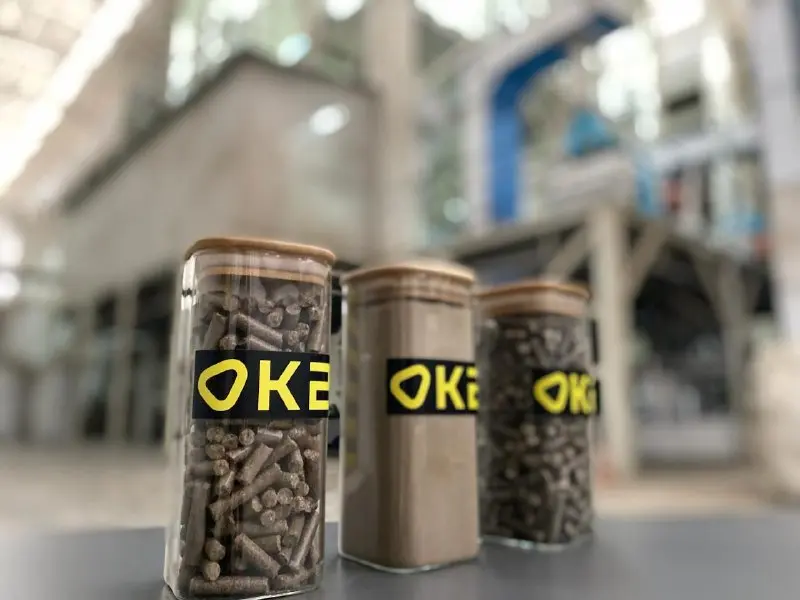
To further evaluate the energetic feed value of K2 sunflower concentrate, the CVB NE2015 system—developed for net energy evaluation in swine diets—was applied. Unlike regression-based models that predict net energy primarily from proximate chemical composition or calculated metabolizable energy (ME), the CVB system calculates the contribution of individual digestible nutrient fractions and accounts for differences in their metabolic utilization efficiency in pigs.
Calculations were performed using the following equation:
NE2015=11,70хDCP+35,74хDCFATh+14,14х(STAam−e+GOS+0,90SUGe) + 9,74хFCH+10,61хAC+14,62хPR+19,52хBU+20,75хETH+12,02хLA+13,83хGLYCEROL,
NE2015 — Net energy, kJ/kg dry matter (DM); DCP — digestible crude protein; DCFATh — digestible crude fat after acid hydrolysis; STAam-e — enzymatically digestible starch; GOS — galactooligosaccharides; SUGe — enzymatically digestible sugars; FCH — fermentable carbohydrates; AC, PR, BU, and LA — acetic, propionic, butyric, and lactic acids, respectively; ETH — ethanol; GLYCEROL — glycerol. Nutrient contents in the equation are expressed in g/kg dry matter (DM).
Since K2 sunflower concentrate is a dry, non-fermented feed ingredient and its existing chemical analysis does not detect organic acids, ethanol, or glycerol, the contribution of these components was assumed to be zero in the calculation. Therefore, a simplified form of the equation was used for K2:
NE2015=11,70хDCP+35,74хDCFATh+14,14х(STAam−e+GOS+0,90SUGe)+9,74хFCH
The raw chemical composition of K2 concentrate was recalculated on a dry matter basis. At a dry matter content of 91.1%, the concentration of crude protein was 487.4 g/kg DM, crude fat — 15.4 g/kg DM, starch — 40.6 g/kg DM, sugars — 80.1 g/kg DM, and crude fiber — 107.6 g/kg DM.
To improve calculation accuracy, experimental nutrient digestibility coefficients obtained from pig digestibility trials on similar high-protein sunflower concentrates were applied. Based on research by CCPA-POTOKY for PROGLOT SFC CP450, the apparent fecal digestibility coefficient of crude protein was 86.6%, and for crude fiber, it was 60.8%. Meanwhile, a trial conducted by the Bangkok Animal Research Center for a similar high-protein sunflower concentrate established digestibility coefficients of 94.59% for crude fat and 95.72% for starch. Thus, the calculation combined experimental values from two independent studies, prioritizing CCPA data for crude protein and fiber, and Bangkok Animal Research Center data for fat and starch, which were not separately evaluated in the CCPA trial. This approach maximized the use of available in vivo swine data while minimizing reliance on book values for digestibility coefficients.
For components lacking experimental digestibility coefficients in both studies, the calculation assumptions outlined below were applied.
Accordingly, based on a crude protein content of 487.4 g/kg DM and its fecal digestibility coefficient of 86.6%, as established in the CCPA-POTOKY study for PROGLOT SFC CP450, the calculated content of digestible crude protein was:
DCP=487,4* 0,866=422,1 g/ kg DM
Since the fat digestibility coefficient was not separately evaluated in the CCPA-POTOKY study, an experimental value of 94.59% obtained by the Bangkok Animal Research Center was used for this fraction. Accordingly, the digestible fat content was:
DCFATh=15,4=0,9459=14,6 g/kg DM
A similar approach was applied to starch, as its digestibility was not separately evaluated in the CCPA-POTOKY trial. Based on the starch digestibility coefficient of 95.72% experimentally established by the Bangkok Animal Research Center, the calculated content of its enzymatically available fraction was:
Certain methodological assumptions were applied to the fat and starch fractions. The crude fat content measured in K2 was considered equivalent to the CFATh parameter, as a separate determination of fat after acid hydrolysis was not conducted. The total starch digestibility coefficient experimentally established in the Bangkok Animal Research Center study was used as an approximation of its enzymatic availability, which is required for calculations under the CVB NE2015 system.
For sugars, which were present in K2 at 80.1 g/kg DM, experimental digestibility coefficients were not available in either the CCPA-POTOKY or Bangkok Animal Research Center studies. Therefore, according to the adopted calculation methodology, their enzymatic availability was conventionally assumed to be 100%. In accordance with the CVB NE2015 equation, the energy contribution of this fraction was further adjusted by a coefficient of 0.90. The content of galactooligosaccharides (GOS) was not separately determined; consequently, their contribution was set to zero in the calculation model.
The evaluation of the carbohydrate fraction of K2 required special consideration. The nitrogen-free extract (NFE) content was 286 g/kg on an as-fed basis. After subtracting the analytically determined starch (37 g/kg) and sugars (73 g/kg), the residual NFE fraction was 176 g/kg as-fed, or 193.2 g/kg DM. Meanwhile, the crude fiber content was 107.6 g/kg DM.
Crude fiber was evaluated separately as a structural carbohydrate fraction. Its apparent fecal digestibility coefficient of 60.8%, experimentally established in the CCPA-POTOKY trial for PROGLOT SFC CP450, was applied. Consequently, the calculated amount of the digestible structural carbohydrate fraction was 65.4 g/kg DM. Its energy contribution in the calculation model was evaluated using the CVB coefficient for fermentable carbohydrates — 9.74 kJ/g.
For the residual NFE fraction (193.2 g/kg DM), whose chemical composition and digestibility were not separately evaluated in either the CCPA-POTOKY or Bangkok Animal Research Center studies, the calculation assumption established in the previous K2 evaluation model was applied. Since this fraction excluded analytically determined starch, sugars, and crude fiber, it was considered an intermediate-availability carbohydrate fraction. Its digestibility coefficient was conventionally set at 97.86%, representing the average between the experimentally established starch digestibility (95.72%) and the assumed total availability of sugars (100%). To account for the intermediate nature of energy utilization for this fraction, a correction factor of 0.95 was applied — the average of the factors assigned to starch (1.00) and sugars (0.90).
Thus, the calculated contributions of the primary nutrient fractions to net energy were approximately: digestible protein — 4939 kJ/kg DM, fat — 520 kJ/kg DM, starch — 550 kJ/kg DM, sugars — 1019 kJ/kg DM, digestible crude fiber — 637 kJ/kg DM, and the residual NFE fraction — 2540 kJ/kg DM.
As a result, the total calculated net energy value was:
As a result, the total calculated net energy value of K2 sunflower concentrate using the adapted CVB NE2015 approach was:

NE_2015≈10205" kJ/kg DM"=10,20" MJ/kg DM",

or
NE_2015≈2439" kcal/kg DM".
Taking into account the actual dry matter content of K2 (91.1%), the calculated net energy value on an as-fed basis was:
NE_2015≈2222" kcal/kg DM".

The resulting value should be considered an estimated calculation adapted to the CVB NE2015 principles rather than a directly measured experimental net energy value. However, incorporating results from two independent in vivo swine digestibility trials significantly strengthened the empirical foundation of these calculations. For crude protein and fiber, apparent fecal digestibility coefficients of 86.6% and 60.8%, respectively, obtained by CCPA-POTOKY for PROGLOT SFC CP450 were applied, whereas for fat and starch, experimental values of 94.59% and 95.72% from the Bangkok Animal Research Center were used. The total enzymatic availability of sugars, the omission of an individually accounted GOS contribution, and the digestibility coefficient and energy utilization pattern of the residual NFE fraction remain calculation assumptions.
Applying the updated CVB NE2015 approach yielded an estimated net energy value for K2 of 2439 kcal/kg DM, or 2222 kcal/kg on an as-fed basis. This value is lower than the previous CVB NE2015 estimate of 2570 kcal/kg DM, primarily due to adopting the new experimental crude protein fecal digestibility coefficient of 86.6% instead of the previously applied 95.72%, as well as updating crude fiber digestibility from 63.40% to 60.8%. Thus, incorporating the CCPA-POTOKY trial data reduced the calculated net energy estimate for K2 by approximately 131 kcal/kg DM, or 5.1%, resulting in a more conservative assessment relative to actual nutrient utilization by swine.
At the same time, this calculated value should not be viewed as final, as the primary source of uncertainty remains the residual NFE fraction of 193.2 g/kg DM, for which direct experimental data regarding chemical composition, digestibility, and energy utilization behavior are lacking. The coefficients adopted for this specific fraction substantially influence the final NE2015 value. Therefore, the calculated value of 2439 kcal/kg DM should be treated as an updated evaluation of K2 energy value based on the available experimental dataset. Further determination of the composition and fermentability of the non-starch carbohydrate fraction will enhance the accuracy of evaluating the product's net energy under the CVB NE2015 system.