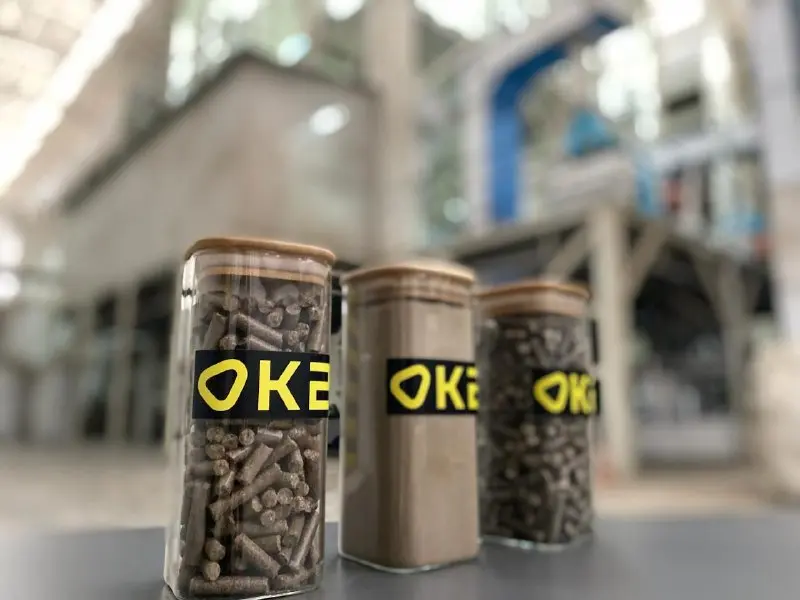
In 2020, sunflower protein concentrate emerged in the feed raw materials market as an alternative to soy products such as soybean cake and soybean meal. This was made possible through the development and implementation of advanced technologies for sunflower kernel fractionation and hull removal, which significantly increases crude protein concentration, reduces crude fiber content, and improves nutrient digestibility. The product immediately drew the attention of feed manufacturers due to global soy market volatility, price fluctuations for processed soy products, supply chain disruptions, the widespread use of genetically modified soybeans worldwide, and the industry’s drive to utilize local raw materials without compromising livestock and poultry performance.
The growing interest in sunflower protein concentrate is driven by several factors. First, Ukraine is one of the world’s leading producers of sunflower seed, ensuring a stable supply of raw materials for high-protein feed ingredient manufacturing. Second, modern processing technologies enable the production of concentrates with a crude protein content exceeding 45%, bringing their nutritional value close to that of soybean meal. Third, research conducted by leading scientific centers demonstrates high amino acid digestibility and the potential for significant—or even complete—replacement of soybean meal in broiler diets without adversely affecting performance.
Modern sunflower protein concentrate is a high-protein feed ingredient derived through the mechanical and technological processing of sunflower seed kernels, involving maximum hull removal. Unlike traditional sunflower meal, the concentrate is characterized by a significantly lower crude fiber content (9–12% versus 16–23% in meal) and an increased protein concentration (44–46% compared to 34–38% in meal). This provides superior feed value and enhanced nutrient digestibility, particularly for young poultry and livestock. The primary advantage of the product is its high protein concentration combined with a well-balanced amino acid profile.
According to research conducted by the National University of Life and Environmental Sciences of Ukraine, the crude protein digestibility coefficient of sunflower concentrate in broiler chickens reached approximately 95%, while crude fat digestibility exceeded 83%, demonstrating high bioavailability of essential nutrients and metabolizable energy.
Comparison of Sunflower Protein Concentrate with Soybean Meal and Soybean Cake
Soybean meal has remained the benchmark plant protein source in compound feed formulations for decades. Its primary advantages include high protein concentration, an optimal balance of essential amino acids, and thoroughly researched nutritional parameters.
At the same time, sunflower protein concentrates closely approach soybean meal in terms of protein digestibility. According to Schothorst Feed Research data on standardized ileal digestibility (SID), the digestibility of crude protein and amino acids in sunflower concentrate is virtually on par with that of soybean meal.
Compared to soybean cake, sunflower concentrate features a more stable chemical composition, lower fat content, and fewer batch-to-batch nutritional variations—factors of critical importance to feed manufacturers (Tables 1, 2)
Table 1. Comparative characteristics of sunflower protein concentrate, soybean meal, and soybean cake
| Parameter | Soybean meal | Soybean cake | Sunflower protein concentrate |
| Crude protein% | 45–47 | 38–42 | 44–46 |
| Crude fat, % | 1,5–2,5 | 6–8 | 1,5–2,5 |
| Crude fiber, % | 3–5 | 5–7 | 8–11* |
| Lysine, % | 2,7–2,9 | 2,2–2,4 | 1,4–1,6 |
| Methionine, % | 0,60–0,65 | 0,55–0,60 | 0,80–0,90 |
| Methionine + Cystine, % | 1,30–1,40 | 1,20–1,30 | 1,60–1,80 |
| Crude protein digestibility, % | 94–96 | 88–92 | ≈95 |
| Amino acid digestibility | Very high | High | High, close to soybean meal |
| AMEn (BARC/WPSA),
kcal/kg |
≈2500 | 2200–2350 | 2447 |
| AMEn (CVB-new), kcal/kg | ≈2500 | 2100–2200 | ≈1950 |
| GMO | Possible | Absent | Absent |
| Quality stability | High | Medium | High |
*Depends on the concentrate production technology.
Table 2. Advantages and limitations of using various protein ingredients
| Criterion
|
Soybean meal | Soybean cake | Sunflower protein concentrate |
| High protein content | ✔ | ◐ | ✔ |
| Balance of essential amino acids | ✔ | ◐ | ◐ |
| High methionine content | ◐ | ◐ | ✔ |
| Low fiber content | ✔ | ✔ | ◐ |
| High protein digestibility | ✔ | ◐ | ✔ |
| Independence from imports | ✖ | ✔ | ✔ |
| GMO factor | ✖/◐ | ✔◐ | ✔ |
| Stability of chemical composition | ✔ | ◐ | ✔ |
| Potential to replace soybean meal | — | Частковий | Високий |
✔ –Advantage; ◐ –Moderate / Medium; ✖ –Disadvantage.
Another advantage of sunflower concentrates is the reliance on locally sourced raw materials, which supports the development of the domestic processing industry. Furthermore, sunflower raw materials are inherently non-genetically modified (non-GMO).
However, it must be taken into account that sunflower concentrate contains a lower level of lysine compared to soybean meal. Therefore, during feed formulation and compound feed manufacturing, amino acid balancing is required—primarily through the supplementation of synthetic L-lysine or other sources of this essential amino acid.
Consequently, modern sunflower protein concentrates represent a promising high-protein raw material for the compound feed industry. Nevertheless, their practical application largely depends on the accurate determination of metabolizable energy parameters, as this key metric significantly influences matrix optimization in feed formulation, production cost-efficiency, and overall animal performance.
Metabolizable Energy of Sunflower Protein Concentrate: Modern Evaluation Approaches and Practical Application Challenges.
A different picture was presented by researchers at Schothorst Feed Research (The Netherlands), who calculated metabolizable energy using the CVB-new system, which is widely utilized in European least-cost feed formulation software. As a result, the AMEn of sunflower protein concentrate was estimated at approximately 1,950 kcal/kg, compared to 2,500 kcal/kg for soybean meal. The difference between the products reached nearly 25%, despite the digestibility coefficients for crude protein and most essential amino acids being virtually identical.
At first glance, these results appear contradictory. However, a detailed analysis of the calculation methodology accounts for these discrepancies. The CVB-new system employs an approach where metabolizable energy is determined via the digestibility coefficients of individual nutrient fractions—crude protein, fat, starch, sugars, fermented indigestible carbohydrates, and organic matter. A key feature of this regression model is the heavy weighting of the carbohydrate fraction digestibility coefficient, which can automatically suppress the calculated AMEn value within the CVB-new system.
Thus, in a study conducted by the Bangkok Animal Research Center (BARC, Thailand) on broiler chickens aged 21–28 days, the metabolizable energy of sunflower protein concentrate was determined to be 2,447 kcal/kg (AMEn). The calculation was carried out using the direct energy balance method, accounting for the Gross Energy (GE) of the feed, excreta energy, and nitrogen retention correction. This aligns with the classical methodology of the World’s Poultry Science Association (WPSA) and is grounded in direct physiological measurements.
A different picture was presented by researchers at Schothorst Feed Research (The Netherlands), who calculated metabolizable energy using the CVB-new system, which is widely utilized in European least-cost feed formulation software. As a result, the AMEn of sunflower protein concentrate was estimated at approximately 1,950 kcal/kg, compared to 2,500 kcal/kg for soybean meal.
The difference between the products reached nearly 25%, despite the digestibility coefficients for crude protein and most essential amino acids being virtually identical.
At first glance, these results appear contradictory. However, a detailed analysis of the calculation methodology accounts for these discrepancies. The CVB-new system employs an approach where metabolizable energy is determined via the digestibility coefficients of individual nutrient fractions—crude protein, fat, starch, sugars, fermented indigestible carbohydrates, and organic matter. A key feature of this model is the heavy weighting of the carbohydrate fraction digestibility coefficient, which can automatically suppress the calculated AMEn value within the CVB-new system.
At the same time, Schothorst Feed Research data demonstrate that in terms of the standardized ileal digestibility (SID) coefficient of crude protein and most amino acids, sunflower protein concentrate is virtually on par with soybean meal. This indicates high bioavailability of the product’s protein fraction and confirms the efficacy of modern manufacturing processing technologies.
Therefore, the variation between 1,950 and 2,447 kcal/kg does not imply that one of the results is incorrect. In fact, they characterize the same product from the perspectives of different evaluation systems.
However, utilizing a value of approximately 1,950 kcal/kg as a universal matrix value for sunflower concentrate may lead to an underestimation of its full nutritional potential. BARC data, as well as results from Ukrainian commercial-scale poultry feeding trials, indicate that actual energy utilization by poultry can exceed the predictions of the CVB-new model.
The primary reason for the discrepancies in AMEn values lies not in the sunflower protein concentrate itself, but in the mathematical model used to evaluate its energy value, the physiological specifics of protein, fat, and carbohydrate energy digestibility in poultry, as well as variations in the microclimatic conditions of bird housing.
Low or high temperatures, combined with elevated relative humidity, force poultry to expend a significant portion of consumed feed energy on thermoregulation. Thus, average temperature and relative humidity during poultry housing serve as major factors contributing to differences in metabolizable energy determination values.
Therefore, in our view, when evaluating sunflower protein concentrate, it is essential to consider the specific objective of the calculations. If compound feed diets are formulated according to the CVB system, it is advisable to utilize AMEn values derived specifically via this methodology. Such an approach ensures maximum compatibility with matrix formulation software and minimizes the risk of under- or overestimating the ingredient’s energy value. Furthermore, as commercial production performance data accumulates for a specific enterprise, fine-tuning the energy matrix becomes possible based on actual poultry performance, feed conversion ratio (FCR), and overall cost-efficiency. At the same time, environmental housing conditions and the specific processing technology of these protein concentrates must be taken into account.
In light of the above considerations, and taking into account our own calculations of gross energy (GE) and metabolizable energy (AME/AMEn) based on individual nutrient fractions, as well as the recommendations of the WPSA (World’s Poultry Science Association), we recommend—primarily for nutritionists utilizing WPSA equations in feed formulation software—setting the metabolizable energy value for „K2” sunflower protein concentrate in the range of 2,200–2,270 kcal/kg. Notably, this range is validated by commercial production results from long-term inclusion of this protein concentrate in broiler diets across leading Ukrainian poultry integrators.
This approach effectively bridges scientific rationale with operational safety, avoiding both overestimation and unjustified underestimation of the energy potential of sunflower protein concentrate.
Thus, sunflower protein concentrates represent a promising high-protein raw material for the compound feed industry. Their inclusion ensures high animal performance, eliminates the risk of GMO presence in both feeds and livestock products, and allows for the optimization of metabolizable energy utilization and overall feed profitability.
Bohdan YEGOROV, Doctor of Technical Sciences, Professor, Academician of the NAAS of Ukraine.Nina VORONA, PhD in Technical Sciences, Associate Professor.Alla MAKARYNSKA, Doctor of Technical Sciences, Associate Professor. Department of Grain and Feed Technology
Odesa National Technological University